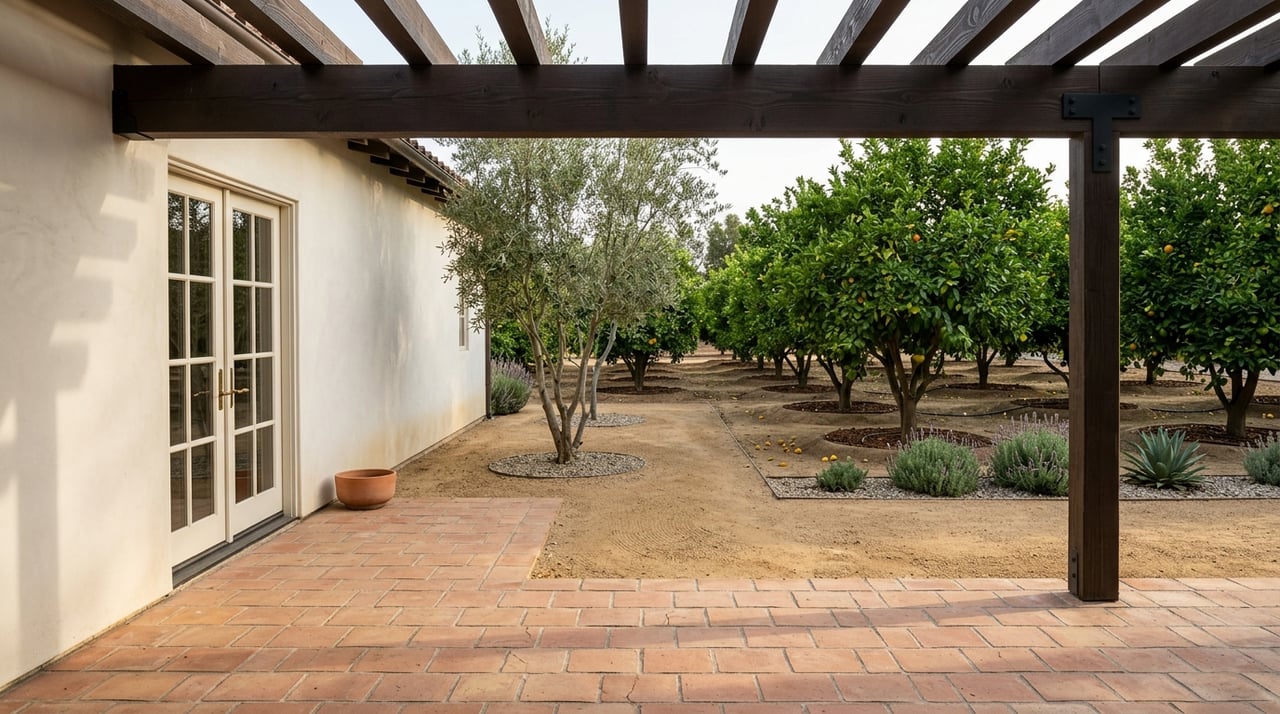
Ojai East End Homes: Orchards, Acreage, and Open Space
May 28, 2026
May 28, 2026
If you are drawn to Ojai for privacy, land, and a stronger connection to the valley itself, the East End often stands out right away. This part of the Ojai Valley offers a very different feel from a typical subdivision, with orchards, larger parcels, custom homes, and a visible sense of open space. If you are considering buying or selling here, it helps to understand what really shapes the area, from land use and water to design review and limited inventory. Let’s take a closer look.
The East End sits on the eastern side of the Ojai Valley and overlaps the City of Ojai and the East End basin area. It is shaped by a semi-rural pattern of land, where orchards, estate parcels, and open views remain central to the experience of living there.
City guidance for the East Ojai Avenue corridor is focused on preserving the area’s rural, eclectic character and sense of openness. Architectural review is used to help new work fit its surroundings, which means the East End tends to feel more custom, layered, and land-oriented than a conventional suburban neighborhood.
For many buyers, that is the appeal. You are not just shopping for square footage. You are often choosing a lifestyle tied to space, setting, and the long-term character of the valley.
Agriculture is not just part of the East End’s history. It is part of the present land-use framework. The Ojai Basin serves wells that support tree crops, residents, and businesses, which reflects how closely homes and agriculture still coexist in this part of the valley.
You can also see that relationship in the available housing stock. Recent East End listings have included acreage, land offerings, and even a property described as having Hass avocado trees. That kind of mix helps explain why East End real estate feels more like a lifestyle micro-market than a standard neighborhood search.
For buyers, nearby orchard land can be a benefit if you value views, spacing, and a rural setting. At the same time, it can affect what is possible on or near a parcel, especially if you are thinking about future development or changes in use.
Ventura County’s land-use framework favors low-density development in the East Ojai area. The Rural designation is intended for residential estates of two acres or more, while Rural Residential parcels generally range from 2 to 10 acres.
The county’s Agricultural designation has a 40-acre minimum. Open Space parcels have a 10-acre minimum, or 20 acres when contiguous with agricultural land. The county also states that it should discourage expansion of Rural and Existing Community designations into East Ojai and Upper Ojai Valley areas.
In practical terms, this helps preserve the East End’s spacious pattern. It also helps explain why you often see a mix of estates, custom homes, orchards, and undeveloped land instead of denser housing formats.
If you are considering a property in the East End, the land may be just as important as the house. Parcel size, zoning, access, water source, agricultural adjacency, and use restrictions can all shape value and future plans.
Ventura County also requires added care around some non-agricultural projects near agricultural operations. Discretionary non-agricultural uses adjacent to agricultural land should establish appropriate buffers, and some requests on legally annexable property within the City of Ojai sphere may require annexation-first treatment.
That does not mean a property lacks potential. It means due diligence matters, especially if you are imagining an expansion, guest structures, new site work, or a different future use.
In the East End, water is not a side issue. It is one of the most important things to understand before you buy. The Ojai Basin underlies the City of Ojai and the valley’s East End, and tributaries draining the East End feed San Antonio Creek and help recharge the basin.
According to the Ojai Basin Groundwater Management Agency, the basin has a maximum capacity of about 85,000 acre-feet and a safe annual yield of about 5,026 acre-feet. The agency also notes that basin levels can fall quickly in drought conditions, citing one example of an 84-foot decline in seven months during 2012.
For a buyer, that makes well status, water source, and basin context especially important. If you are purchasing acreage, orchard property, or an older estate, these details should be part of your review from the beginning.
One reason the East End feels visually distinct is that design expectations are taken seriously. The East Ojai Avenue Design Guidelines were created to preserve the area’s rural, eclectic character and openness, and they address site planning, building form, architectural style, signs, landscaping, lighting, and public improvements.
The Planning Commission uses those guidelines in architectural review for projects in the corridor. The city’s broader design-review process also emphasizes harmonious development that fits Ojai’s mountain-and-valley setting.
For homeowners, this can support a more cohesive sense of place over time. For buyers considering changes, it is a reminder that design freedom exists within a framework that values compatibility and stewardship.
On wooded parcels, it is important to verify tree rules before assuming what can be removed or graded. The city has a tree-protection ordinance for heritage and mature trees, which can affect planning for improvements.
This is especially relevant in the East End, where mature landscaping and natural features are often part of a property’s identity. A parcel may feel expansive, but that does not automatically mean every part of it can be altered in the way you first imagine.
East End inventory is typically thin and highly varied. In a recent Zillow snapshot, the area showed 12 results, with pricing ranging from $995,000 for a 0.63-acre lot to $7,995,000 for a house. The same snapshot included both estate-style offerings and larger land listings, including a 12.21-acre lot.
That spread tells you something important. The East End does not move like a broad, uniform market. It behaves more like a small, acreage-oriented niche where pricing is influenced by land, water, improvements, setting, and scarcity.
By comparison, broader Ojai market snapshots sit in the low-to-mid seven figures depending on source and date. That citywide baseline is useful context, but East End values often require a more property-specific lens.
The East End’s appeal is not limited to private parcels. Open-space context is a major part of the experience. The Ojai Valley Land Conservancy manages roughly 2,300 acres and 27 miles of trail in the valley, with a focus on protecting riparian areas, viewshed lands, adjacent preserve lands, and agricultural lands.
For many buyers, this reinforces what makes the East End feel different. You are not only buying a home. You are buying into a landscape where protected views, trails, orchards, and open land remain part of daily life.
That broader setting can also support long-term desirability. In places where openness is actively valued and protected, the surrounding environment often becomes part of the property story.
If schools are part of your move, the local public-school system is Ojai Unified School District. Schools in the district include Nordhoff Junior High & High School, Legacy High School, Meiners Oaks Early Education School, Mira Monte Elementary School, Topa Topa Elementary School, Summit School, and Ojai Adult School.
Nearby private and alternative options include Oak Grove School and The Thacher School. The area is also close to several well-known local landmarks, including Meditation Mount, Meher Mount, and the Krishnamurti Foundation of America Library and Retreat on McAndrew Road.
These destinations contribute to the East End’s wider sense of place. Depending on what you value, they may add to the area’s appeal through proximity to education, open land, or spaces associated with reflection and the outdoors.
Because East End properties are often more complex than a standard in-town home, careful review is essential. A beautiful setting can come with important land and ownership details that deserve early attention.
Here are some of the most important items to confirm:
Ventura County notes that the Williamson Act is a voluntary contract program that restricts qualifying land to agricultural or open-space use for 10 or 20 years in exchange for preferential property-tax treatment. The county also notes that if a contract goes into nonrenewal, taxes can rise over time, which is why buyers should confirm whether a parcel is under contract.
If you own property in the East End, your home may need a more tailored strategy than a standard neighborhood listing. Buyers here are often focused on factors that go beyond finishes and bedroom count. They may be evaluating acreage, water, orchard potential, privacy, architecture, access, and how a property fits into the East End’s larger land-use pattern.
That is one reason presentation and positioning matter so much in this micro-market. A property with custom design, usable land, or a meaningful setting often benefits from marketing that can tell the full story clearly and attract buyers who understand the value of place.
For distinctive East End properties, a thoughtful strategy can help separate what is merely listed from what is genuinely understood.
If you are exploring a purchase or considering the sale of an East End property, working with a team that understands Ojai’s land, design expectations, and lifestyle market can make the process far more informed. The Patty Waltcher Team brings deep local experience, thoughtful guidance, and a boutique approach to distinctive properties across the Ojai Valley.
Stay up to date on the latest real estate trends.
Our clients have made us the top selling team in the greater Ojai Valley for the past decade. Experience the difference our taste and dedication can provide.
PATTY WALTCHER | CA DRE #01176473
730 East Ojai Av
Ojai CA 93023