Ojai's Market Reports Tell Three Different Stories. Saddle Mountain Has Its Own Market.
September 10, 2026
September 10, 2026
If you have spent any time this year pulling up Ojai market reports, you have probably noticed they do not agree with each other. One read on the second quarter of 2026 put the median sale price at $1.3 million, up 27.6 percent from a year earlier, with homes closing in an average of 39 days. A separate April 2026 recap showed the median sale price falling 7.7 percent from March to April, landing at $1,055,000, with 141 active listings sitting at a median asking price of $1,599,000. A third report from May framed the whole town as a buyer's market, with median asking prices down 30.4 percent in a single month.
Three snapshots, three stories, all technically true, all describing the same eight-thousand-person valley. That is not a data error. It is what happens when a market this small gets summarized by a single number. Ojai sold 21 homes in April 2026 and 40 in June 2026, and that handful of monthly closings ranges from mobile homes to multimillion-dollar estates. A median built on that little volume will swing hard whenever the mix shifts, even if nothing has actually changed for any specific kind of buyer.
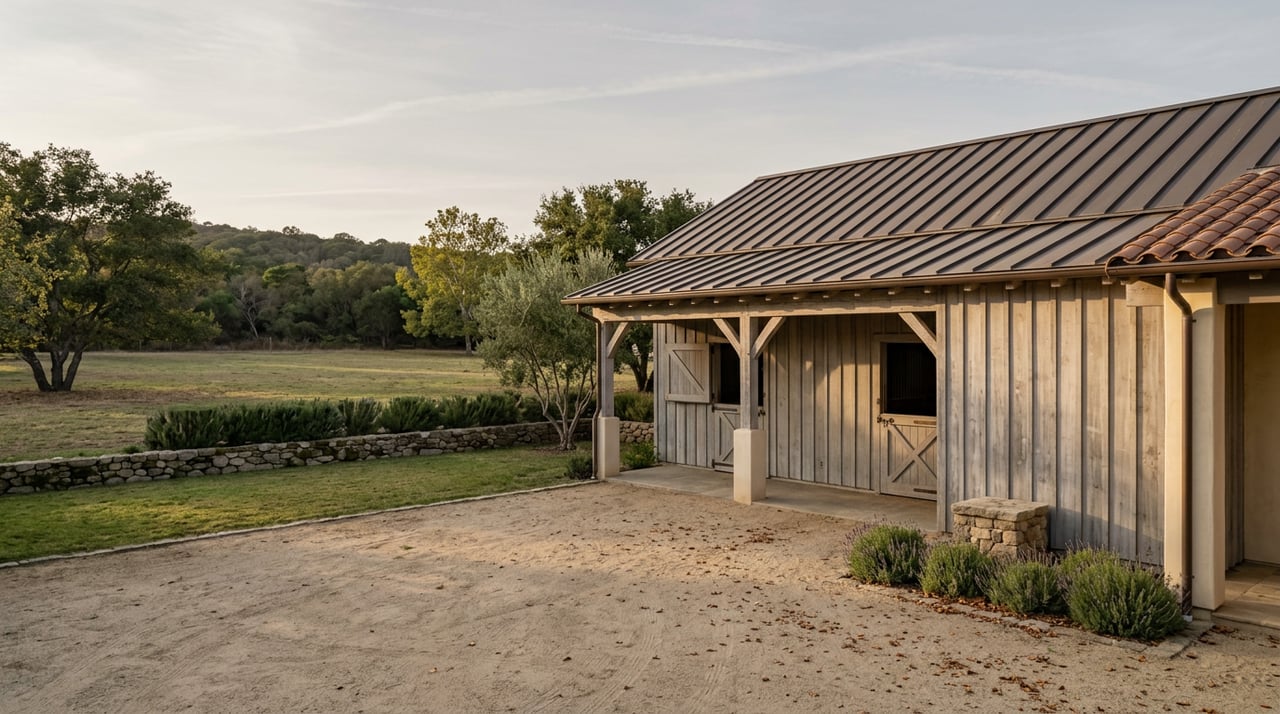
Which brings us to Saddle Mountain Estates, the equestrian enclave tucked between Highway 33 and Creek Road, reached primarily by Encino Drive. None of those headline numbers describe what happens there, because Saddle Mountain does not behave like the rest of Ojai's market. It behaves like its own small, slow-moving economy.
Home values in Saddle Mountain have held in a $1,400,000 to $3,500,000 range for years, largely because so little changes hands. Local listing data consistently notes that only a few homes come up for sale here in any given year. That is not marketing language. It is the plain result of a fixed number of large parcels, most held for the long haul.
The parcels themselves tell you why comparing Saddle Mountain to a town-wide median is close to meaningless. One local source describes the community as homes on two to five acres. Another, describing the same neighborhood, puts the range at three to forty acres. Both are correct. Saddle Mountain was platted as a country subdivision, not a tract, so lot size varies enormously from one address to the next. A five-acre parcel with a barn and a riding arena and a fifteen-acre parcel with pasture and a guest house are both "Saddle Mountain," and they do not price the same way per square foot, per acre, or by any other shorthand a portal algorithm relies on.
Add in the features that make these properties actually function as horse properties: breezeway barns with tack rooms, riding arenas, fenced pasture, proximity to the community's own bridle trails. One recent Encino Drive listing included a six-stall breezeway barn with a tack room and office space alongside the house itself. None of that shows up cleanly in a standard comparable sales report built for conventional single-family homes. It shows up in the price, but only if the person setting that price understands what they are looking at.
This is the friction that catches people off guard, and it rarely gets mentioned until a transaction is already underway. A conventional appraiser working from nearby single-family comps has no natural way to value a breezeway barn or a riding arena. Those improvements cost real money to build and maintain, but they do not map to a per-square-foot adjustment the way a bonus room or an extra bathroom does. Lenders on larger-acreage equestrian parcels also sometimes require agricultural or specialty financing rather than a standard conforming loan, particularly once a property crosses into that five-plus-acre range that shows up so often in Saddle Mountain listings.
None of this makes a Saddle Mountain purchase harder in a bad way. It makes it different in a way worth planning for before you are thirty days into escrow. If you are financing, ask early whether your lender has handled an equestrian property before, and whether the appraiser assigned to your file has valued barns and arenas rather than just bedrooms and baths. If you are selling, the same logic applies in reverse: a listing agent who cannot speak fluently about the property's equestrian infrastructure is going to struggle to justify the price to an appraiser who does not ride.
One more piece of context matters if you are weighing a Saddle Mountain purchase for the long term rather than the next market cycle. Many of these homes look out toward the Topa Topa Mountains and Lake Casitas, and for years that lake view came with an unspoken asterisk during California's long drought stretch. Storage in the lake had fallen to roughly 31 percent of capacity as of September 2022. That picture has changed since. On February 18, 2026, Lake Casitas reached its spillway elevation of 567 feet, the second time it has hit full capacity since April 2024. Recent gauge readings tracked by the Casitas Municipal Water District show the lake sitting just a few feet below full pool, a meaningful shift from where it stood in 2022. None of this changes how a home is priced or financed, but it is worth knowing that the view most Saddle Mountain listings lead with now comes with a fuller lake behind it than it has for most of the last decade.
If you are watching Ojai's market from Los Angeles and trying to time a purchase off town-wide median swings, stop. The numbers moving 27 percent one direction and 30 percent another are describing a blended pool of starter homes, mobile home park units, downtown cottages, and the occasional estate, not the two-to-forty-acre horse properties along Encino Drive. Saddle Mountain's price band has stayed remarkably stable precisely because it operates outside that noise. Scarcity, not sentiment, sets the price here.
That also means the usual advice to "wait for the market to soften" does not really apply. A handful of listings a year is not enough volume to soften or harden in the way a portal headline implies. If a Saddle Mountain property that fits what you are looking for comes on the market, the relevant question is not whether Ojai's median dropped last month. It is whether you are prepared to move on a genuinely scarce property, with financing and appraisal support already lined up for the equestrian details a standard mortgage file will not anticipate.
How many homes typically sell in Saddle Mountain each year? Local listing data describes only a few transactions annually, a reflection of how few of the neighborhood's large parcels change hands at all.
Why do lot size descriptions vary so much for the same neighborhood? Saddle Mountain was developed as a country subdivision rather than a uniform tract, so parcels genuinely range from around two acres up to as large as forty, depending on the specific property.
Does every Saddle Mountain home have mountain or lake views? Many do, given the neighborhood's elevated position overlooking the valley, but views vary by specific lot and orientation, so it is worth confirming for any individual property rather than assuming.
Saddle Mountain rewards buyers and sellers who understand it is not a miniature version of Ojai's broader market, it is its own transaction with its own rules around scarcity, acreage, and equestrian infrastructure. If you are trying to make sense of what a specific property here is actually worth, or you are preparing to list one and want an appraisal and marketing strategy built around what makes it genuinely different, the Patty Waltcher Team has spent decades in these enclaves and knows exactly which details matter to the right buyer. Work With Us.
This article is general information, not legal, tax or financial advice. Consult a qualified professional about your situation.
Stay up to date on the latest real estate trends.
Our clients have made us the top selling team in the greater Ojai Valley for the past decade. Experience the difference our taste and dedication can provide.
PATTY WALTCHER | CA DRE #01176473
730 East Ojai Av
Ojai CA 93023